Showing posts with label nutrition. Show all posts

Fit On Keto: How To Keep Lifting With A Low-Carb Diet


When you chase body-fat loss by removing nearly all the carbohydrates from your diet, something's got to give. Learn how to get a solid workout even when you're in ketosis. 


Many bodybuilders have seen good results from following ketogenic diets. Known as an LCHF (low carb, high fat) diet, keto is designed to force the body to get its energy from ketones the liver produces from fats, instead of from glucose the liver produces from carbs. If you can sustain the diet long enough for your body to enter ketosis, you can lose some major body fat. That said, you can't remove all the carbohydrates from your diet and expect to continue your workouts as usual.

Who Needs Glucose, Anyway?

You do. Glucose provides the primary fuel source for intense muscular contractions. Whenever you're sprinting, going for your set of max squats, or performing box jumps, your body is burning through glucose to fuel that effort.
The keto diet is defined as a dietary approach in which you consume 65 percent of your calorie intake from dietary fats, 30 percent from protein, and just 5 percent from carbohydrates. As you can see, this is an exceptionally low-carb approach to eating.
The idea behind keto is that in response to a drastic reduction in carbohydrates, your body creates an alternative fuel source called ketone bodies. Ketone bodies are a perfectly good fuel for many activities, just not for sustaining an intense exercise program.

Fit On Keto

Don't Try To Out-Exercise A Bad Diet

Why are you interested in keto? Do you just want to lose body fat? Do you want to achieve and maintain a healthy body weight? If either of those sounds like you, you might do better by cutting back on your regular exercise program and spending more time focusing on creating and following a rock-solid nutrition plan. Get your eating down first, then start hitting the gym.
For some people, this nutrition-first approach is the easiest and least complicated way to start shedding weight. Go for a few long, brisk walks each week to sustain a base level of physical fitness as you improve your diet. Once you've got that nailed down, resume your intense strength-training program when the diet ends.
If you don't want to shortchange your strength workouts, you at least need some alternatives.

Switch To A Timed Keto Diet Plan

One of the better options is to simply modify your keto diet to a targeted keto diet. In this approach, you follow the same ground rules as with the keto diet plan, but you add carbohydrates directly before your workout. Eating carbs then will give your body the glucose it needs to successfully complete the workout session—and to adequately replenish your muscle glycogen levels once you finish.
Opt for simple carbs at this meal. This might sound counterintuitive, but it's the fastest way to put some pure glucose into your system. A burst of glucose will quickly take you out of ketosis and provide quick energy for the workout at hand. This approach will also enable your body to quickly clear glucose from your bloodstream so you can go right back into ketosis.
Fit On Keto
Dextrose or maltodextrin will likely be your best bet for a simple carb, but you can also use things like sugary cereal or similar foods.
On off days, you'll simply maintain the standard ketogenic diet. Since you aren't needing glucose to power through intense exercise, there's no need for adjustment.
If you are trying to lose some major body fat and are following this approach, make sure you're accounting for these extra carbs as part of your total daily calorie intake. When you consume more carbs, you must also cut back on your fat consumption.

Fuel Up With Medium-Chain Triglycerides (MCT)

If you don't want to eat more carbs, choose MCTs before your workout. You can get your MCTs from coconut oil or coconut milk, or from medium-chain triglyceride oil.
Your body can break down this form of dietary fat fast enough to give you the energy you need for your workout, as was suggested by research appearing in the International Journal of Sports Nutrition.[1] It may even give you a bit of an extra energy boost as you head into your workout, enabling you to exercise with greater intensity.
The only downside is that some people report gastrointestinal complaints when they consume MCTs.[2] It just depends on how your body reacts to them.

Match Your Workouts To Your Energy Levels

Finally, re-examine your current exercise protocol. When you're getting your fuel from a few extra carbs, you might be able to do your usual high-volume lifting session, completing set after set of all the major lifts. If you take the MCT approach, you may need to lower your objectives a bit.
In any case, make sure your body has had a chance to adapt to your keto diet before you continue the current strength-training program. Once you are fully adapted, your body can use fats for fuel better than it does glucose when you do moderate-intensity work. It may take you some time to become adapted to the keto approach, so don't rush into exercise too soon.
Fit On Keto
You'll also want the overall intensity of your workout to come down. As noted, ketosis supports moderate-intensity exercise better than it does high-intensity exercise. Metabolic conditioning such as treadmill sprints may be incompatible with your keto diet.
Reduce the overall intensity of your lifting sessions by either doing fewer reps per set or lifting less weight. Most people respond best to lifting less weight, since ketosis supports endurance training quite well. A lighter weight with a higher rep scheme falls more along this line of programming. If you don't take the weight too light, you can still maintain lean muscle mass.
Going on the ketogenic diet doesn't mean you should avoid exercise. Put some time into thinking about what type of exercise you want to perform when you're doing keto, then look at ways you can do them in a more moderate but still challenging way. It is possible!


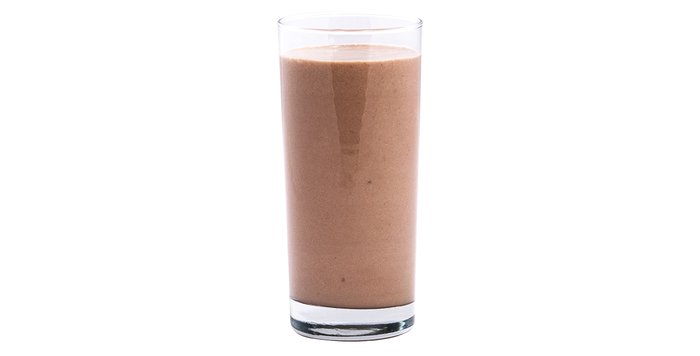
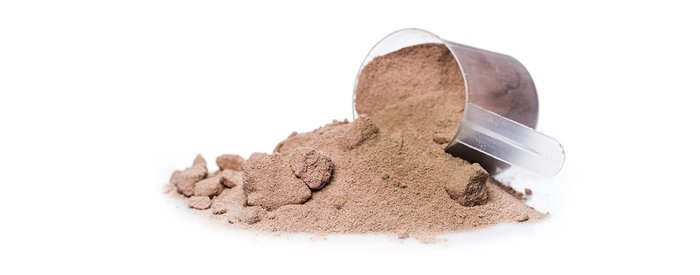
If you're looking to get lean in the new year, it's all about the protein. Learn how to maximize gains by consuming the right amount of this macronutrient. 


Anyone who's been around a gym for more than 30 seconds has probably heard that protein intake is the most critical component of nutrition when it comes to building mass. For some time, the recommended daily allowance (RDA) for protein has been 0.8-1.2 grams of protein per kilogram of body weight. But, the International Society of Sports Nutrition (ISSN) now says that these numbers are low if you're looking for serious gains.[1]

Eat Protein All Day Long

If your goal is to develop greater strength and size, you probably know that you can't just down a protein shake after your workout and call it a day. Your muscles need a continuous stream of amino acids to support muscle protein synthesis, and amino acids are derived from the breakdown of dietary protein.
"The big thing that's changed [in sports nutrition research] is the amount of evidence that the body needs a certain amount of protein all day long to support physical adaptations," says Dr. Lem Taylor, Associate Professor of Exercise Science at the University of Mary Hardin-Baylor, and co-author on the ISSN's updated position.
Eat Protein All Day Long
"Nothing crazy has changed in terms of timing," he says. "The news is that you need to hit optimal feeding windows and dosages all day long to keep positive protein balance and synthesis."
What this means is that you can continue to consume your protein-rich pre-workout and post-workout meals. You just can't load protein right around your workouts and then forget about your eating habits the rest of the day. Instead, your best bet is to divide your daily protein allotment into equal portions and spread them out so you're eating every 3-4 hours to keep the amino acids flowing.
According to the ISSN, the optimal protein intake is around 0.25 grams per kilogram of body weight per meal. Taylor says you can push that number up to 0.4 grams without ill effect. For a 200-pound athlete, that translates to 24-36 grams of protein per meal, or the equivalent of a 4-ounce piece of chicken breast. That's not much chicken per meal, but you will be eating it more times per day.

Consume for Your Body Weight and Goals

You may not know how much protein you need to consume every day. Maybe someone has told you to consume a specific amount of protein per day—say, 140 grams—without basing that on your body weight. If that's how you've determined how much protein you need every day, then you need to revisit that number. As Taylor points out, you'll get the most muscle protein synthesis when you consume the right levels of protein for you—for your specific body weight.
Taylor explains that if you're trying to add mass, you should consume a minimum of 1.6 grams of protein per kilograms of body weight per day. But you don't have to stop there.
"I don't know why someone who's really driven to put on muscle mass wouldn't be eating at least 2 grams per kilogram of body weight per day," he says.
Practically speaking, this means that daily protein needs will vary significantly from person to person. For instance, using the guideline of 2 grams per kilogram of body weight per day, a 150-pound person would need to consume roughly 136 grams of protein per day, while a 250-pound person would need to consume about 226 grams.

Don't Forget to Consume Protein Before Bed

"There's a lot of interesting data out there now on pre-sleep feeding," Taylor says, "which can increase overnight muscle protein synthesis and metabolic rate without influencing or limiting the production of glucose."
Consume protein before bed
Just keep in mind that if you're using supplements to increase muscle growth, stick with casein protein before bed. Casein is broken down more slowly, providing you with a steady, prolonged flow of amino acids, which is ideal for meeting your body's overnight protein needs.

Eat More Protein to Get Lean

Getting lean, particularly if you want to build muscle mass while simultaneously losing fat mass, is a complicated subject. It involves everything from your strength-training program, to how much cardio you're doing, to the specific changes you make to your diet. But, one thing is clear: If you're trying to get lean, increase your protein intake.
"There are some studies out there that show when you're training you can consume 4-5 times as much protein as the original RDA and still not see an increase in adipose tissue," Taylor says. "From a metabolic standpoint, more evidence shows that protein isn't metabolized the same way as fats or carbs. In one study, athletes consumed 4.4 grams of protein per kilogram of body weight per day on a hypercaloric diet without affecting body composition. The study participants consumed a possibly unnecessary level of protein so the researchers could see if it made them gain fat. It didn't."
In another study, athletes in a 4-week study consumed 3.3 grams of protein per kilogram of body weight per day without any negative effects. Participants performed strength training four days a week and interval training six days a week while consuming a low-calorie diet to promote weight loss. One group of participants consumed protein at 1.2 grams per kilogram of body weight per day, while the other group consumed twice as much (2.4 grams).[2]
At the end of the four weeks, the higher-protein group gained an average of 2.5 pounds of lean mass—and lost more fat than the group that consumed less protein. The results suggest that if you want to cut calories and build muscle, shoot for protein consumption in the 2.0-2.4 gram per kilogram of body weight range.[3]

Supplements Can Help

Some people insist that supplements are the only way to get your protein, while others say you have to get them from whole foods. For Taylor, the truth lies somewhere in the middle.
Supplements can help
"You can accomplish anything you want with real food," he says, "but sometimes it's easier to mix up some protein powder—especially for larger people who need to consume as much as 250 grams of protein per day. Between ease and affordability, supplements can be a good way to help you reach your goals. They're not the only way, but they can help."

References

  1. Jäger, R., Kerksick, C. M., Campbell, B. I., Cribb, P. J., Wells, S. D., Skwiat, T. M., ... & Smith-Ryan, A. E. (2017). International Society of Sports Nutrition position stand: protein and exercise. Journal of the International Society of Sports Nutrition, 14(1), 20.
  2. Antonio, J., Peacock, C. A., Ellerbroek, A., Fromhoff, B., & Silver, T. (2014). The effects of consuming a high protein diet (4.4 g/kg/d) on body composition in resistance-trained individuals. Journal of the International Society of Sports Nutrition, 11(1), 19.
  3. Antonio, J., Ellerbroek, A., Silver, T., Vargas, L., & Peacock, C. (2016). The effects of a high protein diet on indices of health and body composition–a crossover trial in resistance-trained men. Journal of the International Society of Sports Nutrition, 13(1), 3.

All about protein:


What is it and how much do you need?


Dietary protein…it’s one of the most important topics when it comes to your physique and making improvements to it.
If you’ve ever wondered what it is, why it’s so important, and how much you should be eating, check out this article.

What are proteins?


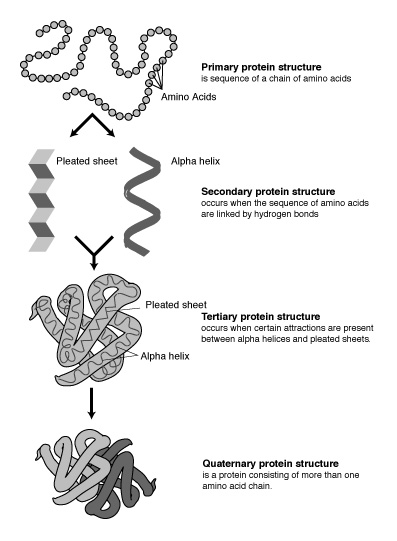
Proteins are organic molecules made up of amino acids – the building blocks of life. These amino acids are joined together by chemical bonds and then folded in different ways to create three-dimensional structures that are important to our body’s functioning.
A diagram of protein structures. For more reading on protein structure, check out Madison Technical College's Lab Manual on Protein Structure here: Image from http://matcmadison.edu/biotech/resources/proteins/labManual/chapter_2.htm

A diagram of protein structures. For more reading on protein structure, check out Madison Technical College’s Lab Manual on Protein Structure.
There are two main categories of amino acids in the body. First, we’ve got essential amino acids – those that the body can’t manufacture, and thus we must consume in our diets.
Some amino acids are conditionally essential, which means that our bodies can’t always make as much as we need (for example, when we’re under stress).
Next, kinda obviously, we’ve got nonessential amino acids – those that the body can usually make for itself.

Essential amino acids
Conditionally essential amino acids
Nonessential amino acids
  • Histidine
  • Isoleucine
  • Leucine
  • Lysine
  • Methionine
  • Phenylalanine
  • Threonine
  • Tryptophan
  • Valine
  • Arginine
  • Cysteine
  • Glutamine
  • Tyrosine
  • Alanine
  • Asparagine
  • Aspartic acid
  • Glutamic acid
  • Proline
  • Serine

Why is it important to get enough protein?

During digestion, the body breaks down the protein we eat into individual amino acids, which contribute to the plasma pool of amino acids. This pool is a storage reserve of amino acids that circulate in the blood.
The amino acid pool in the bloodstream readily trades with the amino acids and proteins in our cells, provides a supply of amino acids as needed, and is continuously replenished. (Think of it like a Vegas buffet of protein for the cells.)
Since our bodies need proteins and amino acids to produce important molecules in our body – like enzymes, hormones, neurotransmitters, and antibodies – without an adequate protein intake, our bodies can’t function well at all.
Protein helps replace worn out cells, transports various substances throughout the body, and aids in growth and repair.
Consuming protein can also increase levels of the hormone glucagon, and glucagon can help to control body fat.1 Glucagon is released when blood sugar levels go down.  This causes the liver to break down stored glycogen into glucose for the body.
It can also help to liberate free fatty acids from adipose tissue – another way to get fuel for cells and make that bodyfat do something useful with itself instead of hanging lazily around your midsection!

How much protein do you need?

How much protein you need depends on a few factors, but one of the most important is your activity level.
The basic recommendation for protein intake is 0.8 grams per kilogram (or around 0.36 g per pound) of body mass in untrained, generally healthy adults. For instance, a 150 lb (68 kg) person would consume around 54 grams a day.
However, this amount is only to prevent protein deficiency. It’s not necessarily optimal, particularly for people such as athletes who train regularly and hard.
For people doing high intensity training, protein needs might go up to about 1.4-2.0 g/kg (or around 0.64-0.9 g/lb) of body mass.2 Our hypothetical 150 lb (68 kg) person would thus need about 95-135 g of protein per day.
These suggested protein intakes are what’s necessary for basic protein synthesis (in other words, the creation of new proteins from individual building blocks). The most we need to consume throughout the day for protein synthesis probably isn’t more than 1.4 – 2.0 g/kg.
But wait – there’s more!
Beyond the basics of preventing deficiency and ensuring a baseline of protein synthesis, we may need even more protein in our diets for optimal functioning, including good immune function, metabolism, satiety, weight management and performance.3 In other words, we need a small amount of protein to survive, but we need a lot more to thrive.
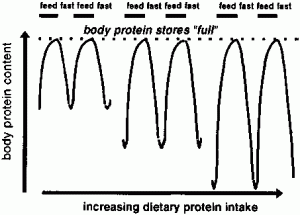
We can only store so much protein at one time. As the graph below shows, the body’s protein stores fluctuate over the course of a day. Notice how the upper limit never increases; the amount of protein in the body just cycles up and down as we eat or fast.

From Millward

Image source: DJ Millward, The Metabolic Basis of Amino Acid Requirements.
The take-home here is that you can’t simply eat a 16-pound steak (a la Homer Simpson consuming “Sirloin A Lot”) once and be done with it. The body needs its protein stores to be continually replenished, which means that you should consume moderate amounts of protein at regular intervals – which just happens to be an important Precision Nutrition guideline.
Consuming more protein may help maintain an optimal body composition (in other words, help you stay leaner and more muscular) and a strong immune system, good athletic performance, and a healthy metabolism. It may promote satiety (i.e. make you feel full longer) and consequently help you manage your body weight.
Indeed, physique athletes such as bodybuilders have long relied on the rule of 1 gram of protein per pound of body weight – or 150 g per day for a 150 lb individual.

For extra credit

When you eat protein is just as important as how much. After resistance exercise (RE) such as weight training, the body synthesizes proteins for up to 48 hours after training.4
Interestingly, during and immediately after RE, protein breakdown is increased as well. In fact, for a brief period, the rate of breakdown exceeds the rate of building.
The body actually drops into a short-term wasting or catabolic state. However, taking in enough protein during the pre- and post-exercise period can offset catabolism. (Check out the Precision Nutrition guide for more on nutrition timing.)
The graph below shows that as the blood concentration of essential amino acids (EAA) increases, so too does protein synthesis.

Source: ABCBodybuilding.com
Image source: ABCBodybuilding.com

The graph below shows how amino acid (and amino acid + carbohydrate) consumption after exercise results in a positive muscle protein balance (in other words, helping muscles rebuild, which is a good thing), while the intake of no nutrients can result in a negative muscle protein balance.
Image source: GSSI

Which protein is best? In general it’s your choice – both protein from plant sources and animal sources seem to work equally well in increasing muscle protein synthesis as a result of exercise.5 The amino acid leucine seems to act as a major stimulus for protein synthesis; good sources of leucine include spirulina, soy protein, egg white, milk, fish, poultry, and meat.

Can I eat too much protein?

If you overeat protein, this extra protein can be converted into sugar or fat in the body. However, protein isn’t as easily or quickly converted as carbohydrates or fat, because the thermic effect (the amount of energy require to digest, absorb, transport and store protein) is a lot higher than that of carbohydrates and fat.
While 30% of the protein’s energy goes toward digestion, absorption, and assimilation, only 8% of carbohydrate’s energy and 3% of fat’s energy do the same.
You might have heard the statement that a high protein intake harms the kidneys. This is a myth. In healthy people, normal protein intakes pose little to no health risk. Indeed, even a fairly high protein intake – up to 2.8 g/kg (1.2 g/lb) – does not seem to impair kidney status and renal function in people with healthy kidneys.6 In particular, plant proteins appear to be especially safe.7

Summary and recommendations

For basic protein synthesis, you don’t need to consume more than 1.4 to 2.0 g/kg (around 0.64-0.9 g/lb) of protein per day.
Nevertheless, consuming higher levels of protein (upwards of 1g per pound of body weight) may help you feel satisfied after eating as well as maintain a healthy body composition and good immune function.
You should consume some protein before and after training to ensure adequate recovery.
Eat, move, and live… better.
Yep, we know… the health and fitness world can sometimes be a confusing place. But it doesn’t have to be.
Let us help you make sense of it all with this free special report.
In it you’ll learn the best eating, exercise, and lifestyle strategies — unique and personal — for you.

Endnotes

1.     Flatt JP 1978; Tappy L, 1996; Blom WA et al., 2006; Latner JD, Schwartz M, 1999.
  1. Lemon et al 1981; Tarnopolsky et al 1988; Tarnopolsky et al 1991.
  2. Flatt JP 1978; Tappy L, 1996; Blom WA et al., 2006; Latner JD, Layman et al 2003; Schwartz M, 1999; Tangney CC, et al. 2005; Kishino Y & Moriguchi S 1992; Marcos A, et al 2003.
  3. Dreyer et al 2006; Koopman et al 2006; Biolo et al 1995; Phillips et al 1997; Norton et al 2006; MacDougall et al 1995.
  4. Brown et al 2004; Anthony et al 2007; Kalman et al 2007.
  5. Poortmans JR & Dellalieux O 2000.
  6. Am Diet Assoc 2003; Millward DJ 1999.

A diet for beginners in bodybuildingسام


A diet for beginners in bodybuilding
Many beginners ask about the diet needed to be overweightI would like to offer you this comprehensive diet free from any type of doping ...First: - Breakfast includes: -- Natural milk (Blash powder) is preferred to be frozen because it contains high levels of calcium about 350 ml- One to two large loaves of bread (source of carbohydrates or starches)- medium black honey dish (source of iron and gives high calories and energy)- One or two cups of yogurt (a source of calcium)6-8 eggs prefer to remove the yolk and whiteness because the protein value is present in the whiteness, the yolk has some damage, such as raising cholesterol and sometimes cause sensitivity in some people and egg whites is one of the best types of animal botulinum, which is easily absorbed by the body.- Bean dish with medium or large oil Size (source of vegetable protein)Second: - Lunch: -- Large rice dish about 350 g or macaroni also about 350 g- Vegetable dish (any type does not require a particular type) but prefer spinach and Bamya because of their contain a large proportion of iron- a large salad dish containing all the ingredients (carrots - lettuce - radish - tomatoes - cucumber - onions). It is preferable to add oil and salt to the salad as the oil has a large amount of saturated fats that increase the size of the muscles unlike the unsaturated fats (unsaturated fats) This dish contains a high quantity of vitamins that help to strengthen nerves.- Large loaf bread is a source of starch- For meat about 200-250 g, whether beef or meat and preferably from the thigh or white meat (chicken) and preferably chicken or fish and recommend fish because it has a high proportion of phosphorus, which gives high energy because it enters the ADP (adenosine di phosphate) Which turns into ATP (adenosine triphosphate), the body's primary energy compound and also has the best source of animal protein.- It is possible to replace rice or pasta with a dish of boiled potatoes mashed with boiled boiled eggs and this dish is very delicious and combines starch and animal protein at the same time.Third: - Dinner:Such as breakfast but replaces black honey with white honey because it gives the body health and high nutritional value.*** NB Please keep away from soft drinks as they block self and also chocolate.*** This system will increase your weight with training and regularity you will notice a difference in weight after the first month at least 7.5 - 10 kg without resorting to a supplement or industrial protein.

Amplify muscles using clean carbohydrates with a diet program


After talking about the difference between clean calories source and calories coming from random sources that do not benefit in the process of muscle rehabilitation, we will talk today about the clean carbohydrates needed by the body to build muscle mass without leading to a significant increase in weight and accumulation of grease In the body.
The basic principle is that we enter 500 to 1000 calories a day in excess of what the body burns. We know that the body burns calories in metabolism (metabolism) and takes advantage of those calories in power generation.
We also burn during the exercise, especially bodybuilding exercise and "Cardio" a lot of calories. So if we want to amplify our muscles, we have to get into our bodies between 500 to 1000 calories more than we burn daily, which is the muscle tissue needs energy to restore itself during the recovery. For example, we burn 400 calories on a treadmill over 40 minutes on the device.
We burn the same during exercise weights in the gym, we burn about 800 calories in the exercise daily. During the rest of the day, our body burns its total (body weight multiplied by 4) calories through exercise, sitting, walking, sleeping, etc. If we weigh 100 kg we burn about 100 x 4 = 400 calories during the day even if we do not exercise.
Of course these are approximate numbers. So a 100-kg man who has two hours of exercise every day, including 40 minutes of "cardio" and the rest a weight workout, burns about 1,200 calories a day. That is, this person must enter into his body daily about 1,700 to 2200 calories a day if he wants to amplify his muscle mass.
This technique helps the body to acquire an almost pure muscle mass, provided that the application of this theory is accompanied by an accurate diet program based on high purity proteins and clean carbohydrates. This is exactly the opposite of the old way of taking "anything and everything" during the amplification period.
It should be noted here that the process of amplifying muscle mass using the technique of "clean carbohydrates" takes longer than the old technology, but the results are "pure muscles" rather than a combination of muscle and grease, in addition to the body (half nap) throughout the year, rather than Big crunch all year except tournament season.  


Dietary program of amplification consists of 5 meals a day:
1) Whole boiled eggs - 6 boiled egg whites - 2 pieces of brown toast - 1 teaspoon peanut butter - 1 cup natural orange juice without adding sugar.
2) The amount of protein (protein) of any brand.
3) Roasted chicken breast (boiled or grilled) - 1 teaspoon of ketchup or "Barbeque Sauce" - large boiled or grilled potato - 1 large banana or 2 small bananas - about 20 unsweetened unsweetened almonds.
Meal 4) 300 g of roasted or boiled red calf meat, 2 cups cooked brown rice with water or steam without adding oil, ghee or butter - a large bowl of salad made of vegetables with tomatoes and a teaspoon of oil Olive and a teaspoon of natural vinegar.
5) The amount of 2 protein (scoop / min) of any protein.
Do not forget to add a cup of coffee (Nescafe) without sugar, or 3 cups of Arabic or Turkish coffee that we know during the day, especially after breakfast and before going to the gym, caffeine helps burn fat and gives the body energy in the exercise.
This food table contains almost 73 grams of most unsaturated fats (pure fat), 385 grams of carbohydrates, 280 grams of protein


Bodybuilding Food


Bodybuilders need food very much, as it is an important factor to inflate muscles along with exercise. Without it, it is difficult to inflate the muscles of the body. The muscles of the human body are made up of bundles containing muscle fibers. The protein is very important in rebuilding the tissues in the body. [3] In addition to the protein, it also needs carbohydrates, unsaturated fats, and vitamins. Each of these nutrients has its usefulness Especially for the improvement of body shape and muscle amplification. [4] Protein Protein is the first nutrient needed by bodybuilders, it is necessary to rebuild muscle tissue after exercise stress. There is a daily requirement of protein for the bodybuilding, and if not received this amount will not inflate the muscles, but will be destroyed if the amount of protein taken very few. [5] The bodybuilding player can get protein from two main sources: food, protein products As a dietary supplement. In food, protein is found high in meat, fish, and dairy products, and one of the best foods containing protein: [6] Tuna. Chicken (especially chicken breast). eggs. Red meat such as beef, calf, and lamb. the milk. Cheese (cheese Quraish). whey. Synthetic protein is usually derived from food mainly, and the most important food derived from protein is whey. [7] Unsaturated fats Bodybuilders use unsaturated fats (M: NSA) to reduce weight. The main source of energy instead of carbohydrates leads to the burning of stored fats in the body, in addition to the fact that unsaturated fats have many health benefits, they are very useful for the heart and circulatory system, and regulate blood sugar. [8] Unsaturated fats are found in the following foods : [9] oils (to be non-fried) such as olive oil. Nuts. Avocado. Carbohydrates prefer bodybuilders to eat carbohydrates with a glycemic index (L: g). These carbohydrates are the least expensive because of their high digestibility. [10] Carbohydrates also stimulate the secretion of insulin in the blood, Of nutrients, thus increasing the muscle's usefulness of food, and swells faster. [11] A useful carbohydrate source for bodybuilders: [12] oatmeal. sweet potato. Brown rice. The beans. Vitamins and minerals Bodybuilders benefit from the benefits of vitamins and minerals. Due to their exhausting exercises and injuries to various body parts, bodybuilders enter minerals and vitamins, especially vitamin D, into their diet to accelerate the healing of such infections, Muscle injuries, [13] as well as being important for the immune system and bone and muscle strength. [14] Bodybuilders benefit from various types of vitamins and minerals, most notably calcium, vitamin D, potassium, China, [15] and can be obtained from food or through dietary supplement products, [16] and are found frequently in the following foods: [17] fruits. Vegetables. Nuts. Herbs. Water Water is essential not only for bodybuilders, but for all, everyone must drink enough water a day to ensure a healthy and healthy body. Drinking plenty of water (in batches) helps stimulate metabolism in the body, [18] That water supplies the body with sufficient energy in the day, [19] and that water is necessary for the cells of the body, which is necessary for the health of the brain. [20] Bodybuilders drink large quantities of water, because it stimulates metabolism, it helps to amplify the muscles, The only case in which bodybuilders reduce their drinking water In the final periods before the competition, to dry their bodies, which makes the muscle more prominent and clear when they come to the theater review. [21] Food programs for bodybuilders Dietary programs for bodybuilders in general contain high proportions of protein, in addition to containing sources of energy , But any diet differs from another program depending on the target. The bodybuilding player who wants to amplify his body needs more carbohydrate than those who want to dry. [22] The perfect bodybuilder who wants to lose weight and burn fat needs a sleeve (Eg, oatmeal and milk is an example of a good breakfast), and protein (such as boiled eggs), low-carb diets, and relatively high amounts of useful fats (such as unrefined oils and nuts). [23] ), 24 and then a lunch containing chicken breast, to begin the exercise after lunch two hours, to extend the body energy, and food needs about 4 hours to digest, [25] the body can benefit from the protein that contains this food after Finish the exercise, where the The meal is about to be fully digested, and it is preferable to drink one industrial protein scoop after exercise directly, to feed the tired body muscles of the exercise, [26] The meal after eating the exercise is preferred to contain high amounts of protein Or tuna good meal